Transforming a Local Service Business: Turning a Chaotic SEO Mess into an Automated Client Pipeline
Every service business owner in South Florida eventually runs into the same problem. In an attempt to attract customers, websites become overloaded with endless walls of keyword-stuffed text written for search engines instead of real people, while the entire operational workflow — from document intake to billing — slowly collapses into manual chaos.
Recently, we at Sfixy completed a full rebuild of the digital infrastructure for Family Star Company (Hollywood, Florida), a business providing administrative, household, and adjacent legal-support services for private clients, including notary services, certified translations, immigration form assistance, bookkeeping, and credit score improvement.
Using this real-world case study, we want to demonstrate why outdated keyword stuffing tactics no longer work — and how proper UI/UX combined with workflow automation can transform a website from a useless online brochure into the company’s most valuable operational employee.
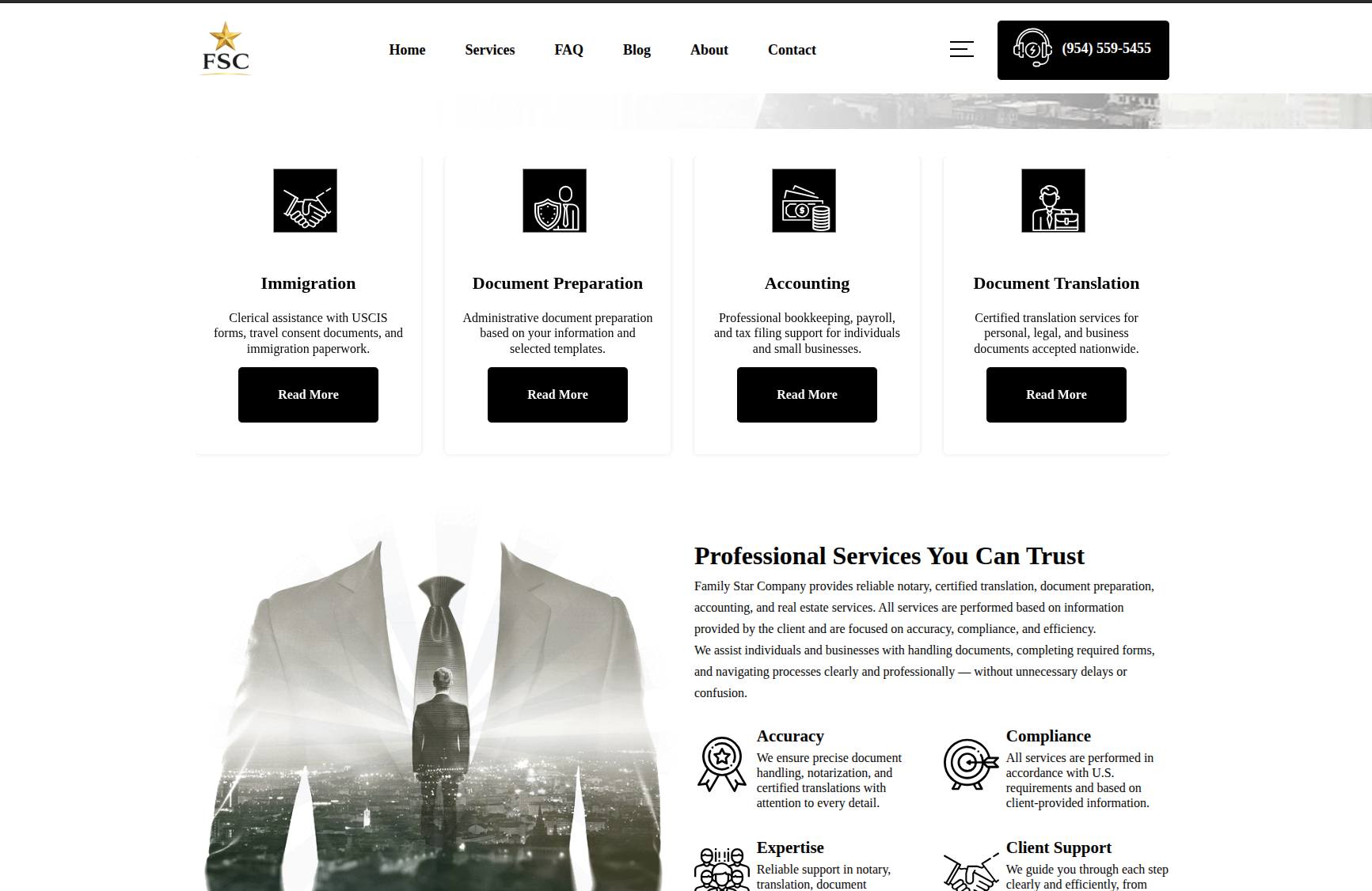 Redesigned Family Star Company website with streamlined navigation, improved UI/UX, and service-focused structure.
1. Anatomy of the Chaos: What the System Looked Like Before
The starting point was a textbook example of a typical local U.S. service business setup:
A Wall-of-Text Website
The homepage consisted of an endless stream of SEO-heavy text overloaded with keywords for the sake of questionable search rankings. Reading it as a real human being was physically exhausting, while conversion rates were approaching zero.
Operational Bottlenecks Everywhere
Even when clients managed to survive the confusing interface and submit a request — or, more commonly, when inquiries arrived through completely different channels like direct calls, SMS, or messengers — the internal workflow immediately fell into routine chaos.
Managers had to manually:
- write emails,
- collect documents scattered across multiple chats,
- verify files manually,
- generate invoices by hand,
- and later spend time checking bank statements to figure out whether payment had actually arrived.
The entire system operated at the absolute limit of human-error dependency. As soon as several unrelated requests arrived simultaneously, the team started drowning in routine work, losing files inside email threads and delaying response times.
2. Cleaning Up the Mess: Redesigning for Real People and Legal Compliance
The first step was completely eliminating the old keyword-stuffed mess. Modern customers in Florida value their time and are extremely cautious about personal data security. If a website looks like a spam platform from 2010, it immediately destroys trust.
Clear Dynamic Structure
We cleaned up the service chaos and reorganized everything into a modern, user-friendly carousel interface. Users can now switch between service categories in a single click — from Document Preparation and Certified Translation to Immigration Form Assistance and Credit Score Improvement.
Clients immediately understand the full scope of available services from the first screen.
Legal Compliance
Operating in this niche within the United States requires strict legal compliance. We implemented legally reviewed disclaimers throughout the system, including statements such as:
“Family Star Company LLC is not a law firm, attorney, or accredited representative and does not provide legal advice.”
This protects the business from unnecessary lawsuit risks and regulatory scrutiny while clearly defining the boundaries of responsibility for clients.
A “Two-Click” Interface
Instead of endless questioning and confusing workflows, users now interact with a clean, step-by-step interface. A client from Boca Raton or Miami opens the site, selects the required service, and immediately sees a streamlined form ready to accept their request.
3. The Automated Operational Pipeline
However, a polished frontend alone accounts for only about 20% of the final result. The real transformation happened when we connected the new interface and all external communication channels into a unified internal operational pipeline.
No matter where the client comes from, their request enters the same structured workflow.
The new processing flow now looks like this:
Intake
As soon as the request is submitted, the system instantly assigns it a unique ID inside a centralized database.
Workflow Control
The team immediately receives notifications through email and messenger systems, allowing managers to move the client through clearly defined workflow stages inside the admin panel:
- New
- In Progress
- Payment
- Done
One-Click Actions
Managers no longer need to manually collect files through endless email chains.
If documents are missing, a single click generates a secure upload link that allows the client to securely upload additional files directly from a smartphone.
Need to accept payment? Another click generates a secure Stripe payment session and automatically delivers an invoice to the client.
Main Takeaway from Part One
A clean and understandable website is not just a modern design trend — it acts as a filter that removes operational chaos before it even enters the system.
But for that machine to function properly, there must also be a powerful, secure, and purpose-built backend architecture underneath it, instantly connecting user actions, management interfaces, payment systems, and real-time staff notifications into a single ecosystem.
In Part Two, we will open the hood and examine the engineering side of the system itself: how we built this CRM using the proprietary GPCL framework (by SNK Software) and PHP 8.3, how we implemented secure encryption for confidential client documents, and how we automated Stripe invoicing workflows without relying on heavy, bloated frameworks and vulnerability-ridden plugin ecosystems.
Need a Custom Business Workflow or Client Portal?
Sfixy develops custom websites, operational platforms, secure client portals, workflow automation systems, and backend infrastructure for modern service businesses across South Florida.
Whether you need a streamlined intake system, internal CRM, secure document handling, Stripe integration, or a complete business workflow redesign, we can help engineer a reliable long-term solution tailored to your operations.