From Concept to Production: Building a Custom Service Marketplace MVP
Most local service businesses start with a familiar formula: a homepage, a list of services, a contact form, and a phone number. That may be enough for a small operation, but it becomes increasingly limiting when a company offers multiple services across different locations and needs a structured way to process customer requests.
Recently, we at Sfixy completed and launched the first production version of My Florida Smart Home, a custom-built home technology and installation service website serving South Florida.
The project combines a modern service-oriented interface, dedicated landing pages, a portfolio of real installation projects, location-based availability checks, and an online request workflow backed by PostgreSQL.
Rather than waiting for an entire marketplace platform to be completed, we took a more practical approach: build a functional minimum viable product (MVP), launch it into production, and establish a foundation for further development.
1. The Challenge: More Than Another Service Website
A company offering TV mounting, accent wall installation, smart home setup, and Wi-Fi networking faces an interesting design problem. These services are related, but customers searching for them have very different expectations.
Someone looking for an 85-inch TV installation wants to know whether the installer can handle a large display and unusual wall construction. A customer struggling with Wi-Fi coverage wants a reliable network, not a gallery of television installations.
Putting everything onto a single generic services page creates unnecessary friction. On the other hand, building completely separate websites for every service makes navigation, branding, and future development harder to maintain.
We needed an interface that could:
- Present several service categories without overwhelming visitors.
- Provide dedicated landing pages for individual services.
- Clearly communicate the geographic service area.
- Show actual installation projects and technical work.
- Help customers determine whether their ZIP code is supported.
- Accept structured service requests without requiring a phone call.
- Remain practical to maintain and extend after launch.
The goal was not simply to publish an attractive website. It was to build the first operational layer of a service business.
2. Designing the Customer Experience Around Real Services
One of the most important decisions was to organize the website around the customer's actual reason for visiting.
Instead of treating the homepage as an endless collection of SEO keywords, we designed a clear visual hierarchy with focused service categories, prominent calls to action, and simple navigation.
Dedicated Service Pages
The website separates its core offerings into individual sections:
- TV Mounting & Installation
- Accent Walls
- Smart Home Setup
- Wi-Fi & Networking
Each service has different technical considerations, customer questions, and visual material. Dedicated pages allow us to explain these differences without turning the homepage into a massive wall of text.
They also create a more useful landing experience for visitors arriving from search engines or local marketing campaigns.
Visual Consistency Without Generic Templates
The design follows a consistent visual system across the website: restrained typography, generous spacing, a recognizable color palette, and reusable interface patterns.
However, the content and presentation remain specific to each service. A TV mounting page should communicate installation expertise, while a networking page should focus on coverage, connectivity, and reliability.
This distinction matters. A reusable design system makes development efficient, but it should not make every service page feel identical.
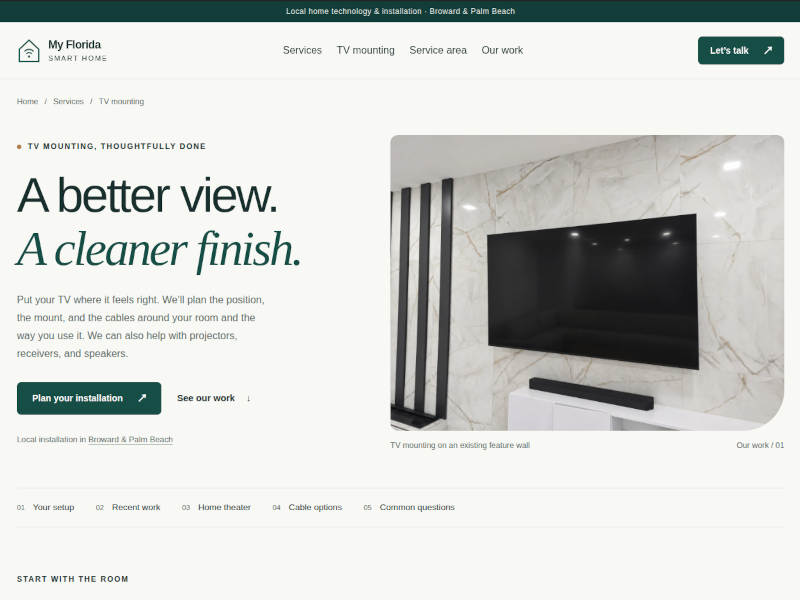 Dedicated TV mounting landing page featuring real installation photography, service information, and a direct customer request path.
3. Showing Real Installation Work
For an installation business, photographs of completed projects often communicate more than generic marketing statements. Customers want to see actual results, unusual mounting situations, and examples of how technical challenges were handled.
Instead of filling the website with stock photography, we developed a dedicated Our Work section built around real installation projects.
The portfolio includes examples of TV mounting, networking equipment, cable management, and other technical installations. Some projects focus on the finished result, while others document the installation process itself.
A Project-Based Portfolio
Rather than presenting an unstructured collection of photographs, the portfolio organizes work into individual projects.
Each project can contain multiple images, allowing visitors to examine the installation from different perspectives. This is especially useful for technical work where the final appearance does not reveal the complexity of the installation.
For example, a television mounted on a decorative wall may look straightforward from the front. Additional photographs can demonstrate the mounting hardware, cable routing, or reinforcement required behind the display.
We also implemented category filters so visitors can browse work relevant to their interests without searching through an unrelated collection of images.
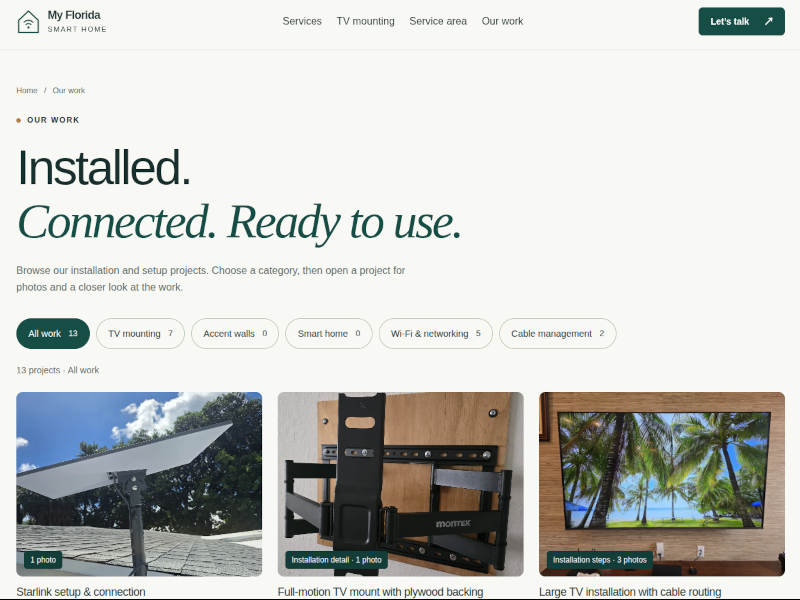 Project-based installation portfolio with category filtering, real customer work, and detailed installation photographs.
The result is more than a decorative gallery. It provides practical evidence of the services offered and helps establish trust before a customer submits a request.
4. Location-Based Service Discovery: Solving the ZIP Code Problem
Local service businesses have another challenge that traditional websites frequently handle poorly: geographic availability.
Simply claiming to serve an entire county can create unrealistic expectations. A technician may cover several neighboring cities regularly while certain addresses require additional travel or may not be available at all.
For My Florida Smart Home, the primary service area covers Broward and Palm Beach counties in South Florida.
Instead of relying exclusively on a long list of city names, we incorporated ZIP-code-based service discovery into the customer request experience.
Why ZIP Codes?
City names alone are not always precise enough for service coverage decisions. ZIP codes provide a more structured way to determine whether a customer's location falls within the supported area.
The initial workflow allows customers to select their ZIP code and service before proceeding with a request.
This creates several practical benefits:
- Customers can check location eligibility before submitting a request.
- The business receives structured geographic information.
- The interface avoids publishing an excessively long list of locations.
- The request process remains consistent across multiple service categories.
Most importantly, the website communicates the service area as an operational constraint rather than an exaggerated marketing promise.
5. From Website Visitor to Structured Service Request
A modern business website should do more than encourage customers to call. It should make the first interaction predictable and reduce the amount of information that must be reconstructed later.
For the initial release, we implemented a lightweight online request flow based on service and ZIP-code selection.
The experience follows a straightforward sequence:
- The customer identifies the required service.
- The customer selects their ZIP code.
- The customer completes the request form.
- The system accepts the request and provides a unique reference number.
- The business contacts the customer to confirm details and arrange an appointment.
This last step is particularly important. A submitted request is not automatically a confirmed appointment.
Clear Confirmation Instead of False Booking Promises
Many websites confuse customers by displaying a generic success message that makes it unclear whether an appointment has actually been scheduled.
We intentionally distinguish between receiving a request and confirming a service appointment.
After submission, the customer receives a confirmation screen with a reference number and an explanation that the business will follow up to arrange a time.
This keeps expectations realistic while giving both parties a traceable request reference.
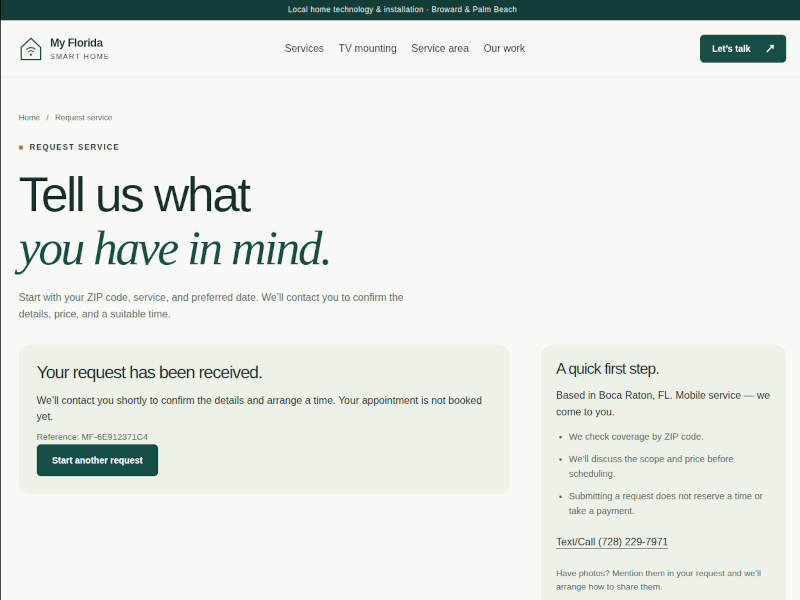 The production MVP accepts service requests, generates unique reference numbers, and clearly explains the next steps to customers.
6. Engineering the MVP: GPCL, PHP 8.5, and PostgreSQL
The first production release was implemented using GPCL (General Purpose Classes Library), our in-house PHP framework, adapted for PHP 8.5.
GPCL has already been used in other custom business applications developed by Sfixy, including CRM and workflow automation projects. Reusing an established internal codebase allowed us to concentrate on the requirements of this project rather than spending time assembling another framework stack.
A Purpose-Built PHP Application
The initial release did not require a large, complex backend system. Its immediate purpose was to deliver service information, handle the customer-facing request workflow, and support the website's operational data.
Building these capabilities on an existing PHP foundation made it possible to launch a functional MVP without delaying the entire project for features that were not yet necessary.
This is an important engineering principle: software should be designed for its actual requirements, not for an imaginary workload that may never materialize.
Why PostgreSQL Instead of MySQL?
For a website of this size, MySQL would have been perfectly sufficient. PostgreSQL was not selected because a basic request form requires an especially powerful database engine.
The reason was architectural consistency.
PostgreSQL was already selected as the database technology for the broader project. Introducing MySQL exclusively for the initial website would mean supporting two different database systems without a compelling operational benefit.
By using PostgreSQL from the beginning, we reduced the number of technologies in the overall stack.
The immediate workload may not justify every capability PostgreSQL offers, but avoiding unnecessary technological diversity can be more valuable than optimizing a single small component in isolation.
Keeping the Initial Release Focused
One of the easiest ways to delay a software project is to keep adding infrastructure before the first customer can use it.
For this release, the priority was straightforward:
- Publish the customer-facing website.
- Make services and coverage areas understandable.
- Present real installation projects in a browsable portfolio.
- Provide a functional request submission process.
- Store application data in PostgreSQL.
- Deploy a usable first version into production.
We deliberately avoided treating the MVP as a finished enterprise platform. The architecture and the feature set reflect the current operational requirements.
7. From Development to a Live Production Website
There is a significant difference between a polished design mockup and a website that customers can actually use.
A screenshot does not accept service requests. A prototype does not need to handle real visitors navigating between pages or completing forms from different devices.
The first release of My Florida Smart Home is now deployed as a functioning website, with its main service sections, project portfolio, service area information, and online request workflow available to customers.
This marks the practical transition from concept to production.
Why Launching an MVP Matters
Waiting until every possible feature is implemented often means waiting too long to collect useful feedback.
An MVP makes it possible to evaluate the real customer experience rather than relying entirely on assumptions made during development.
Questions such as whether customers understand the services, use the ZIP-code selector, explore installation examples, or successfully complete a request become measurable once the product is available.
The initial launch therefore serves two purposes: it provides a working customer-facing system and creates a practical starting point for improving it.
8. What's Next: Beyond the Initial MVP
The current release represents the first stage of a larger project.
Future development is intended to evolve My Florida Smart Home into a comprehensive service marketplace platform with its own API and more advanced booking and service management capabilities.
Those features are outside the scope of the current MVP. The important result today is that the initial website is already operational and capable of receiving customer requests.
9. Main Takeaway: Build What the Business Needs Today
Not every business needs a full CRM, marketplace engine, or enterprise booking platform on launch day.
What it does need is a website that communicates its services clearly, guides customers through the right process, and reliably captures the information required to move the business forward.
The My Florida Smart Home project demonstrates how thoughtful UI/UX design, a focused custom application, and practical technology choices can turn an idea into a functioning production MVP.
The key is not building the largest possible system. It is delivering a useful one, with enough flexibility to grow when the business actually needs more.
Need a Custom Website, Booking System, or Business Platform?
Sfixy designs and develops custom business websites, online request systems, booking workflows, CRM platforms, and digital infrastructure for service businesses in South Florida and beyond.
Whether you need a modern website with real functionality, a custom customer intake process, or an application that replaces repetitive manual operations, we can develop a solution around your actual business requirements.
From an initial MVP to a more advanced operational system, our focus is on practical engineering, maintainable architecture, and software that performs real business work.